Choosing the Right Rake for the Job
Spring Rakes and Lawn Rakes
Spring rakes — also called leaf rakes or fan rakes — have flexible steel or poly tines spread in a wide fan. They're designed for moving volume fast: leaves, grass clippings, and light debris off turf without pulling up grass. A.M. Leonard offers spring rakes in bulk packs of 6 with 18-tine and 24-tine steel heads, and poly lawn rakes in bulk packs of 12 and 18 — the standard buying unit for landscaping crews equipping a trailer.
Bow Rakes and Garden Rakes
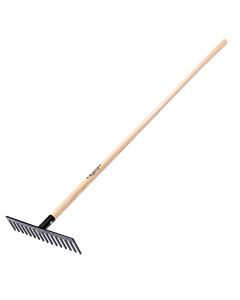
Bow rakes (also called hard rakes or garden rakes) use short, rigid metal tines set at a 90-degree angle to a sturdy head braced by two curved bows. They're built for heavy-duty soil work: breaking up compacted ground, leveling beds, backfilling, spreading gravel and mulch. A.M. Leonard's all-steel straight rakes come in 18-tine and 24-tine heads on 66-inch handles — the same all-steel construction has earned a Lifetime Warranty.
Grading Rakes and Landscape Rakes
Grading rakes have extra-wide aluminum heads — 24, 36, and 42 inches — designed for finish leveling over large areas: new lawn installs, infield grading, spreading topdressing or seed. They're a production tool, not a homeowner tool. A.M. Leonard stocks grading rakes with coated handles and heads up to 42 inches wide — the right spec for commercial lawn renovation work.
Thatch Rakes
Thatch rakes have double-sided blades — sharp on both the pull and push stroke — that slice and remove the layer of dead grass and organic matter above the soil line. Used when thatch exceeds half an inch, which restricts water and nutrient penetration. Industrial models in this category are built for repeated commercial use, with a spring-brace head and aluminum handle.
Forestry Rakes
Forestry rakes have a heavy-duty 22-tine steel head and reinforced construction for clearing brush, moving debris on rough terrain, and firebreak maintenance. A.M. Leonard stocks them in bulk packs of 6 — the standard quantity for fire crew and right-of-way maintenance contracts. Not for turf use.
Buying Rakes for Crews: Bulk Packs and Handle Options
Most landscaping operations buy rakes in quantity for a reason: tools go missing, handles break, and equipping multiple crews from a single order is more efficient than single-unit purchasing. A.M. Leonard's bulk packs are priced for this:
- Bulk Pack of 6 — Spring Rakes: 24-tine steel head, American ash or Tuff-Flex composite handle. Best for leaf and debris crews.
- Bulk Pack of 12 or 18 — Poly Lawn Rakes: 18-inch poly head, 54-inch handle. Lightweight, replacement-friendly.
- Bulk Pack of 6 — Forestry Rakes: 22-tine steel head. Right-of-way, utility, and fire suppression crews.
For American ash handles: durable, traditional, restorable with a replacement handle when broken. For Tuff-Flex composite handles: weather-resistant, lighter, no splintering. Aluminum handles on wide grading rakes keep weight down on heads that would be exhausting with wood. For volume pricing on large orders, get a quote or contact our team.
Aluminum Screening Rakes and Specialty Options
Aluminum screening rakes combine the wide head of a grading rake with a closely-spaced tine pattern for finishing work: spreading and leveling sand, topdressing, and aggregate screening. Available in 24, 36, and 42-inch heads with 66-inch coated handles. Also in this category: thatch rakes for lawn renovation and forestry rakes for land clearing — both stocked for commercial quantities.
Yard & Garden Rakes FAQ
What is the difference between a leaf rake and a bow rake?
A leaf rake (spring rake) has long, flexible tines spread in a fan — designed for moving lightweight debris like leaves and clippings without digging into turf. A bow rake (garden rake or hard rake) has short, rigid metal tines at a 90-degree angle to a braced head — built for heavy work: breaking soil, leveling gravel and mulch, and backfilling. Most crews need both.
What is a hard rake used for?
Hard rakes — also called bow rakes or garden rakes — are used for soil preparation: breaking up compacted ground, leveling beds, removing rocks and debris from planting areas, spreading mulch and gravel, and backfilling around plants. Their rigid steel tines can handle materials too heavy for a flexible leaf rake. A.M. Leonard's all-steel straight rakes are the standard choice for landscaping crews.
Are the rakes sold in bulk packs or individually?
Both. Most A.M. Leonard rakes are available as single units and in bulk packs of 6, 12, or 18. Spring rakes ship in packs of 6, poly lawn rakes in packs of 12 and 18, and forestry rakes in packs of 6. Bulk packs are priced per-unit lower and are the standard buying format for landscaping operations equipping multiple crews. Use the quote tool for large-volume orders.
What is a grading rake and how is it different from a standard garden rake?
A grading rake (landscape rake) has a much wider head — 24 to 42 inches — versus a standard garden rake's 14 to 18 inches. That width is designed for leveling large surface areas quickly: finish grading before seeding, spreading topdressing, and smoothing infields. A.M. Leonard carries Midwest Rake grading rakes in 24, 36, and 42-inch head widths with lightweight aluminum construction and coated handles.
What handle material should I choose — ash, composite, or aluminum?
American ash is traditional, strong, and repairable — the preferred choice for crews that replace handles rather than full tools. Tuff-Flex composite handles are lighter, weather-resistant, and won't splinter — better for high-turnover crews. Aluminum handles are standard on wide grading rakes where head weight already demands a lightweight shaft. All handle types are available across A.M. Leonard's rake line.
Do A.M. Leonard rakes have a warranty?
A.M. Leonard's own-brand tools carry a Lifetime Warranty against manufacturing defects, including the all-steel straight rakes and spring rakes. This applies to the tool head — replacement handles are available separately for ash-handled models. Third-party brands like Midwest Rake and Seymour carry their own manufacturer warranties. Contact A.M. Leonard's team for warranty claims.
When should I use a thatch rake instead of a leaf rake?
Use a thatch rake when the layer of dead organic matter between the grass blades and soil exceeds about half an inch — at that depth, thatch blocks water, air, and fertilizer from reaching roots. A leaf rake won't cut through it. Thatch rakes have sharp double-sided blades that slice on both the pull and push stroke. For large areas, a power dethatcher is faster; thatch rakes are best for spot treatment and small lawns.
What makes forestry rakes different from standard garden rakes?
Forestry rakes are built for rough terrain and heavy material — clearing brush, moving debris on uneven ground, and firebreak maintenance. They have a reinforced steel head with fewer, heavier tines widely spaced to handle branches and coarse debris without clogging. They're not designed for turf or garden bed use. A.M. Leonard stocks forestry rakes in bulk packs of 6, the standard quantity for fire suppression and right-of-way crews.